

Does it matter if a song was made by AI?
Yes. But why? And what does it mean for the idea of creativity?
My friend
has a blog (go follow her - she is funny and smart) and has a little vignette about enjoying (and then lamenting) a song that turns out to have been made by AI. I think it’s really interesting.A couple pieces I wanted to pick out:
A few weeks ago, Spotify’s “Discover Weekly” playlist1 fed me a song called “Without Me,” by an artist called Orion7. I noticed partway through the track that the lyrics were clearly identical to the Eminem production of the same name.
…
Anyway, this cover by “Orion7” is done in 60s/70s American soul style with a splash of Big Band. The rhythm is undeniably catchy. And because the lyrics are what they are (outrageous, snappy), it grabs you. I was grabbed! I wanted to know more.
Well, it turns out that Orion7 is AI, leaving Mikaela feeling a bit out of joint:
I have no real Point to make here. This incident has disturbed me since it happened. It has caused me to doubt my previously-ironclad commitment to The Cover, not to mention my credentials for quickly identifying “AI slop” when I encounter it in the wild.
Everything feels so fragile these days. We are trying to create and sustain value and meaning wherever we can. We are attempting to navigate the Brave New World that we’ve created through the miracle of computation, backed by thousands of years of human effort. If we can’t immediately sense “this soul-ish cover of an Eminem song is Garbage, Actually,” what do we have left?
As a person of many takes, I really want to have Answers to the question of What to Do About AI and Art. I’ve even written a few whole darn essays on the subject. But I still find that every time I encounter a new instance, I mostly just have more questions.
If someone finds an AI-generated song to be pleasantly engaging, was that experience false? Is the thing ‘garbage’ by definition because it wasn’t created by a ‘real’ creative force? What is creativity at all?
As the technology gets better, it’s going to be more and more common for us to engage with things that were wholly artificial without ever knowing it. How does that affect the meaning of the experience? How does that shape our sense of trust?
Is it going to encourage us to try to remain intentionally oblivious as a means of self-protection? In the way that many of us watch sports while knowing-but-pretending-to-not-know that many of the players are using performance-enhancing-drugs?
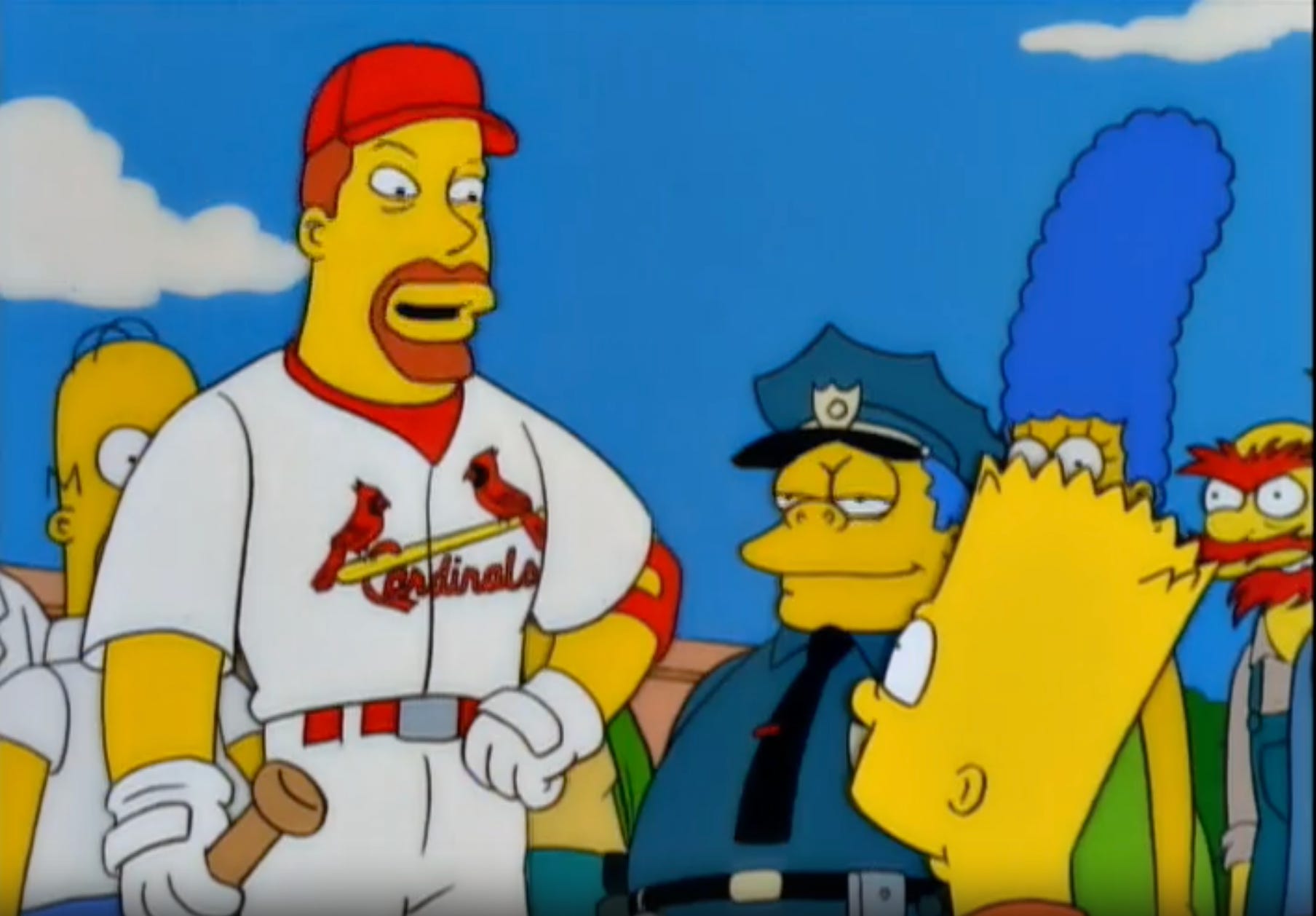
Young Bart here was right. We are spying on you pretty much around the clock.
But why, Mr. McGwire?
Do you wanna know the terrifying truth, or do you wanna see me sock a few dingers?
Dingers! Dingers!
Is it similar to loving a work of art and then discovering that the artist was a monster in real life?
There is one thing I do feel confident about: even if machines can make art that is genuinely great, even if we ultimately decide to just accept this and pretend to feel okay about it, even if we just genuinely do become okay with it, human beings are still going to be driven to create for themselves.
As I wrote back in June, in The Process is the Point:
These things will continue to matter, not because they produce the ‘best’ possible content, but because they are the products of a thinking mind engaging with the world—a mind trying to make a world.
Obviously, the desire to make something ‘good’ is a significant part of what drives us to create. But that quality is also inherently tied to the process of creation. If I knit a blanket, I want it to be the blanket that I knitted. And I’d be annoyed if someone swapped in a more perfect machine-made version. If I want to write an essay, I want it to be my own essay, not a ‘perfect’ essay. If I wanted a perfect essay, I would read something written by Joan Didion or David Foster Wallace.
AI is going to create a lot of weird experiences for us as consumers of creativity. I think (and hope, and believe) that it doesn’t have to degrade our capacity to make creative things.
https://en.wikipedia.org/wiki/Pierre_Menard,_Author_of_the_Quixote
I find myself referencing this a lot lately. It's about the curious gymnastics one does when caring about a work through the lens of the author.
The joke, which is in the title, is that a guy is reauthoring Don Quixote. Not in the sense of translation, update, or remaster, but with himself as writer, redoing the writing task from the ground, with the ultimate goal of arriving at the text of Don Quixote, word for word.
I highly recommend the story of course.
I am on the other end of the spectrum. If art is not merely a convoluted, noisy medium for communication between auteur and receiver, if it can be appreciated for its formal beauty and our own reaction regardless of the artist's intent, then computers are going to make art, and they are going to do it very well. They can explore the possibility space much faster. I would hope people would use AIs as tools to do things that would be unachievable by us mere mortals, leaving us our classic expressions and domains.
There are arguments that these AIs are trained in an unethical manner, that their use harms the environment, etc. I am bullish on the idea that we will be able to sort out those problems: paying artists equitably for the exploit of their works for training, finding energy systems and trade-offs that all sides will find just and equitable, using non exploitative labor for human feedback and training, etc.
I don't think anyone should dislike music created by an AI any more than they dislike finding shapes in a cloud. If someone creates an AI song for propaganda, hate the propagandist, or the propaganda endeavor, not the song. Or the AI.